

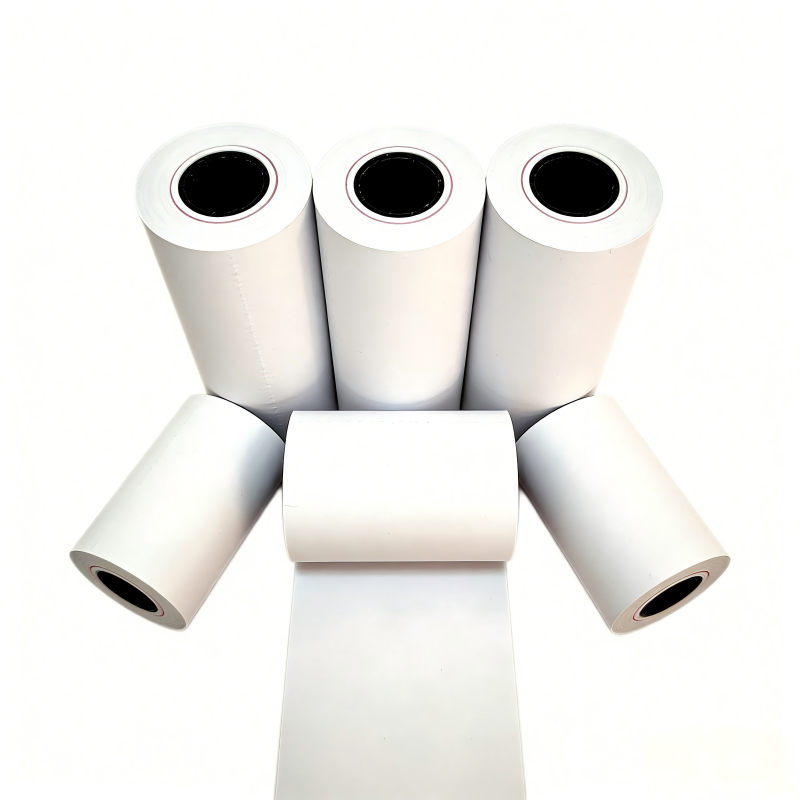
Behind every retail transaction, every restaurant checkout, and every logistics delivery, there is an unassuming yet crucial player – thermal POS paper. As one of the most basic consumables in global business operations, thermal POS paper is quietly driving continuous improvement in business efficiency through its technological core and continuous innovation.
Technology History: From Ribbons to Inkless Printing
Since its commercialization in the 1970s, thermal printing technology has completely transformed the way we check out and print labels. Traditional ribbon printing requires frequent replacements, while thermal technology achieves inkless printing through the principle that a special coating develops color when heated. This not only reduces equipment maintenance costs but also makes the printing process quieter and faster, perfectly suited for high-frequency transaction scenarios.
Core Technology: Coating Determines Quality
The difference in the quality of thermal paper lies primarily in the coating formula. Premium thermal paper utilizes a two-component chemical system:
Developer: Determines the clarity and contrast of printed content.
Stabilizer: Ensures printed content retains its color for 3-5 years under proper storage conditions.
Sensitive agent: Affects the balance between printing temperature and speed.
Modern environmentally friendly thermal paper commonly uses phenol-free and BPA-free formulas, ensuring performance while being safer and more environmentally friendly.
Diverse Applications: Beyond Cashier Receipts
Today, thermal paper has evolved into a rich product matrix:
Standard Cashier Paper: Suitable for most retail scenarios such as supermarkets and convenience stores.
High-Strength Durable Paper: For receipts or documents requiring long-term preservation.
Color Thermal Paper: Enables red, blue, green, and other color printing through a special coating.
Double-Layer Carbon Copy Paper: Simultaneously generates customer and archive copies.
Waterproof and Oil-Resistant Paper: Designed for special environments such as catering and outdoor use.
Industry Trends: Intelligent and Sustainable Development
With the deepening of commercial digitalization, thermal paper is deeply integrating with intelligent systems:
Intelligent Pre-Printing: Pre-printing brand logos and fixed information enhances a professional image. QR Code Integration: Connecting Offline Transactions with Online Services
Environmental Innovation: Expanding Applications of Biodegradable Substrates and Recycled Pulp
Selection Guide: Key Parameters to Match Your Needs
When choosing the right thermal POS paper, consider:
Print Clarity: High-quality paper remains clear even at high speeds.
Shelf Life: Choose the shelf life based on financial and tax requirements.
Compatibility: Ensure perfect compatibility with your printer model.
Standard Specifications: Common widths range from 57mm to 80mm; custom sizes are available.
A Global Quality Commitment
As a professional manufacturer integrating industry and trade, we deeply understand the regulatory requirements and usage habits of different markets worldwide. From raw material selection to coating formulation, from slitting precision to packaging protection, every step undergoes rigorous quality control to ensure that every roll of thermal paper performs consistently in various business environments.
In an era where digitalization and physical experiences converge, thermal POS paper, a traditional product, is being revitalized through continuous innovation. It is not only a recorder of transactions but also an extension of a brand’s professional image. Choosing high-quality, reliable thermal paper injects a stable and efficient foundation into your business operations.
We are committed to providing global customers with thermal paper solutions that meet international standards, using quality and professionalism to ensure that every transaction is clear, durable, and reliable.
Post time: Dec-29-2025